Phone: +94 (0) 112 68 71 18Contact Us

Gender and Social Inclusion In Post-Disaster Recovery Measures

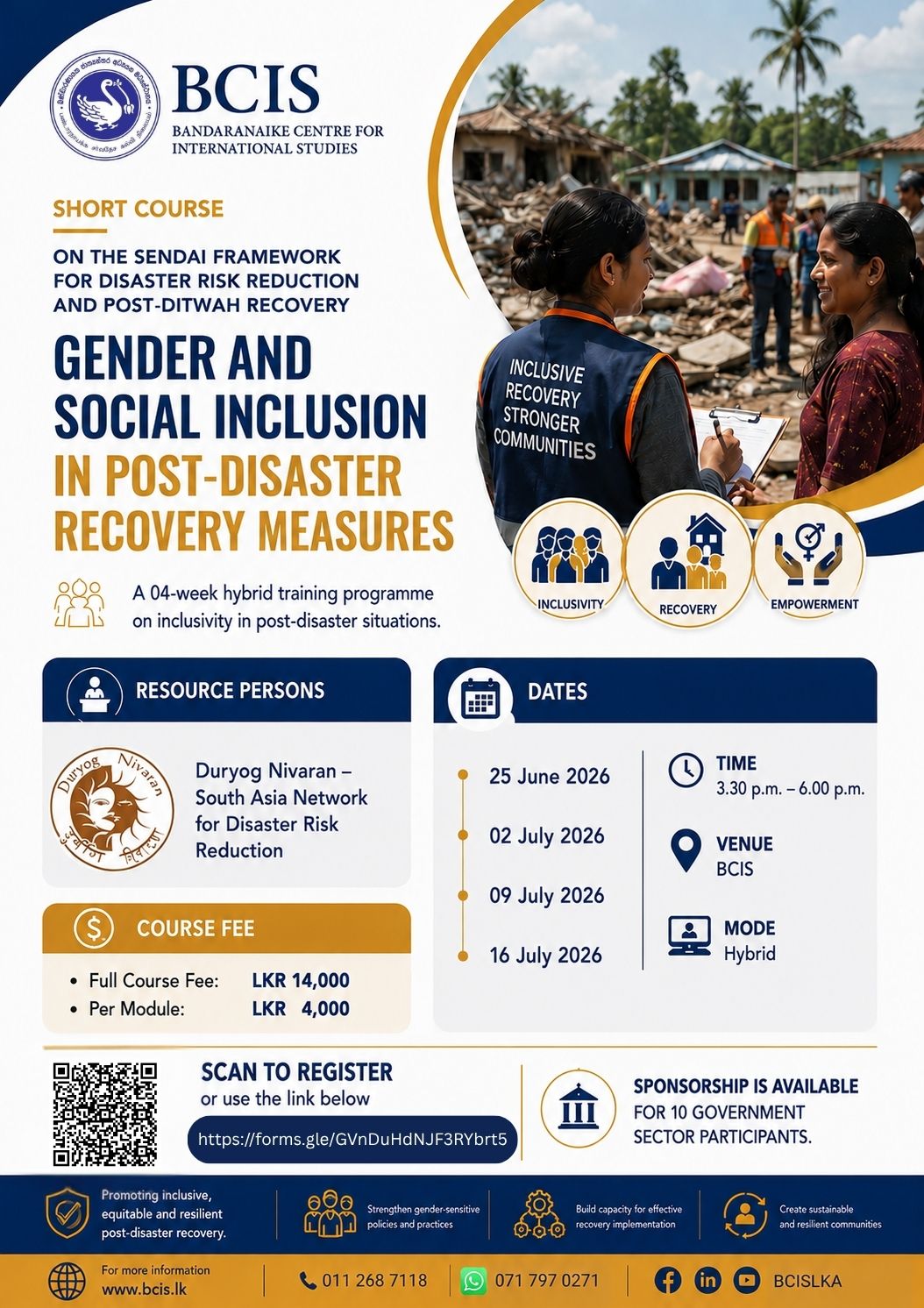
Join this engaging short course on Gender and Social Inclusion in Post-Disaster Recovery Measures, offered by the Bandaranaike Centre for International Studies (BCIS).

🌍 Are you ready to explore how inclusive recovery can build stronger and more resilient communities after disasters? In a world increasingly affected by natural hazards, climate-related events, and humanitarian crises, effective recovery goes beyond rebuilding infrastructure. It requires a people-centered approach that ensures the meaningful participation and empowerment of all members of society, particularly those who are often left behind.

The Short Course on Gender and Social Inclusion in Post-Disaster Recovery Measures, offered by the Bandaranaike Centre for International Studies (BCIS), will take you through an insightful and practical journey into the principles, challenges, and best practices of inclusive post-disaster recovery and disaster risk reduction.

This course will be facilitated by Duryog Nivaran – South Asia Network for Disaster Risk Reduction, a leading regional network dedicated to strengthening community resilience and promoting inclusive, gender-responsive approaches to disaster risk reduction and recovery across South Asia.
Course Highlights

  • The global landscape of peace and conflict has undergone significant transformation, with the erosion of post–Cold War principles such as multilateralism, legal norms, and rights-based peacebuilding. Contemporary conflicts, including the war on Gaza, highlight the limitations of liberal peace frameworks and reflect a shift toward securitisation, geopolitical bargaining, and conflict management rather than resolution.
     
    Today’s conflicts are increasingly shaped by complex and overlapping factors, including regional power competition, identity politics, and digital mobilization, blurring traditional distinctions between war and peace. As a result, conflicts have become more protracted and difficult to resolve, while peace is often maintained through containment and informal mechanisms.
     
    This short course provides participants with a structured and accessible framework to understand these evolving dynamics. It equips students with critical analytical skills to interpret contemporary conflicts, apply global insights to regional and local contexts such as Sri Lanka, and engage more effectively in academic, professional, and policy-oriented discussions on peace and conflict in the post-liberal era.

Target Groups

Anyone who wants to interpret contemporary conflicts and engage more effectively in discussions on peace and conflict in the post-liberal era.

Prerequisites

open to anyone

Class Schedule

Session Details:
 
1 – After Gaza: Why the Liberal Peace No Longer Explains the World – 22 May 2026
2 – Conflicts in the Post-Liberal World: Why Intractability Is Rising04 June 2026
3 – ⁠⁠Illiberal Peace: How Stability Is Produced Through Control, Not Resolution – 11 June 2026
4 – Liberal vs Illiberal: A Collapsing Binary? – 18 June 2026
5 – Contemporary Political Violence: Digital, Communal, and Everyday – 25 June 2026
6 – ⁠Managing Uncertainty: Everyday Peace, Informal Practices, and Hybrid Governance – 09 July 2026

Meet the Facilitator

Andrea Novellis holds a PhD in International Relations from the University of Milan. He is currently Civil War Paths Fellow at the Centre for the Comparative Study of Civil War, University of York, and a Fellow at ITALIM (Italy and the Politics of Food Security), University of Naples L’Orientale. His research examines rebel governance, wartime and post-war party transformation, and the ideological trajectories of armed movements, with a regional focus on the Kurdish regions and Sri Lanka. His broader research interests include early warning systems, crisis anticipation, and the political economy of conflict.

His recent publications include “The Divided Self: How Ideological Compartmentalization Drives Rebel-to-Party Success in Sri Lanka” (Democratization, 2026) and “Programmatic Incompatibility: Ideology, Trust, and the Limits of Rebel Cooperation among Syria’s Kurdish Actors” (Civil Wars, forthcoming)

Course Fee
14000 LKR Full Series, 4000 LKR Per Session
Course Duration
02 July 2026, 09 July 2026, 16 July 2026, 25 June 2026